What it is
Irminsul is my private cloud for family and friends: photos, files, films, documents, notes and a Minecraft server, plus the sites and tools I build myself. It runs as Docker Compose stacks on ordinary rented servers, with no Kubernetes. One person looks after it, so every part has to be easy to read, back up and restore.
The servers
Three servers carry production, and each has one job. The cloud server runs the family apps, single sign-on, the secrets vault, monitoring, backups and the admin console. The platform server runs webplatform, my product for client websites, and the self-hosted analytics. The game server runs only Minecraft. Two more machines hold nothing anyone depends on: a staging server with test data for webplatform, and a build server that builds and tests my own images. Neither can reach the other servers, and neither holds a production credential.
What people use
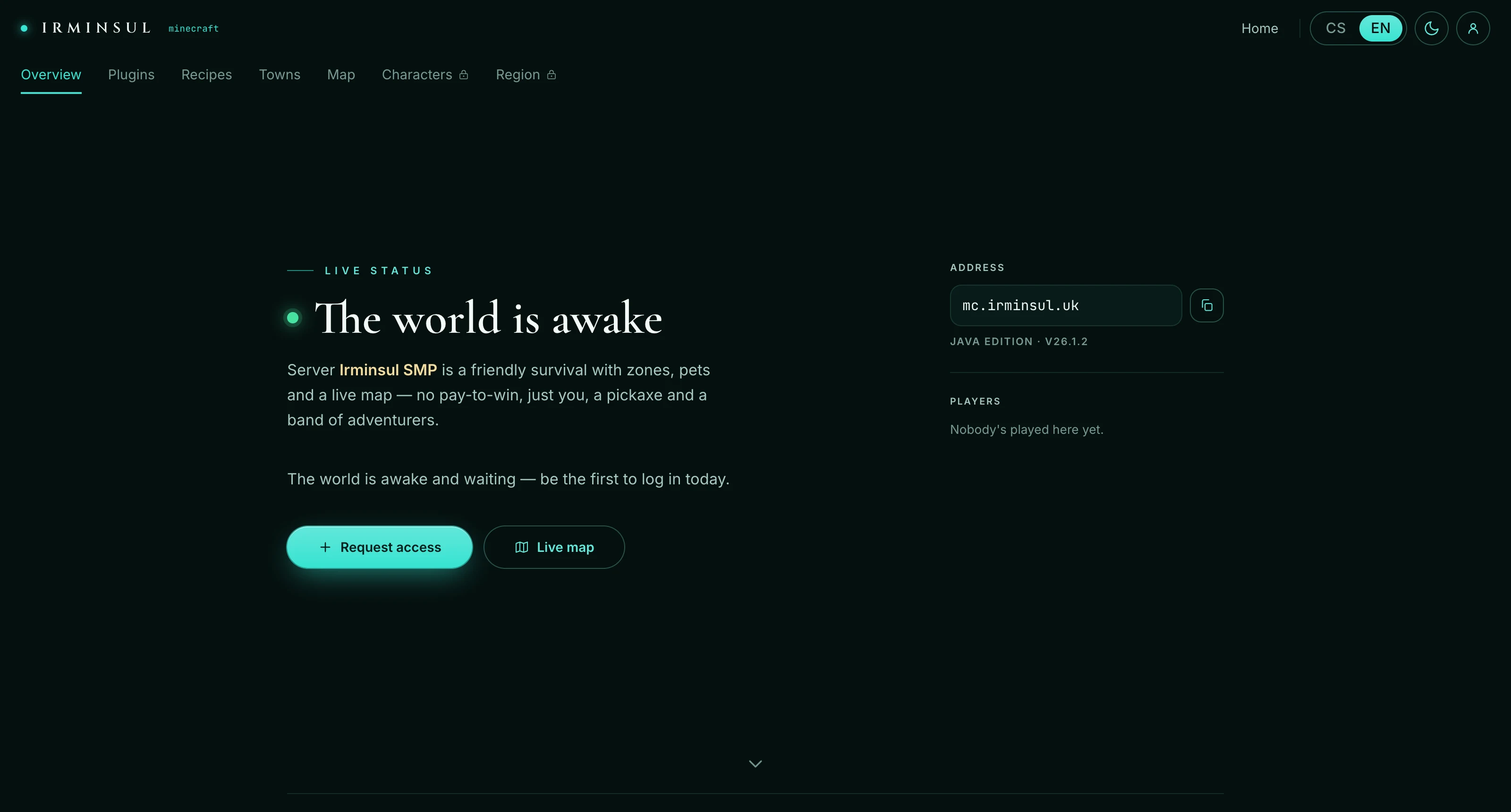
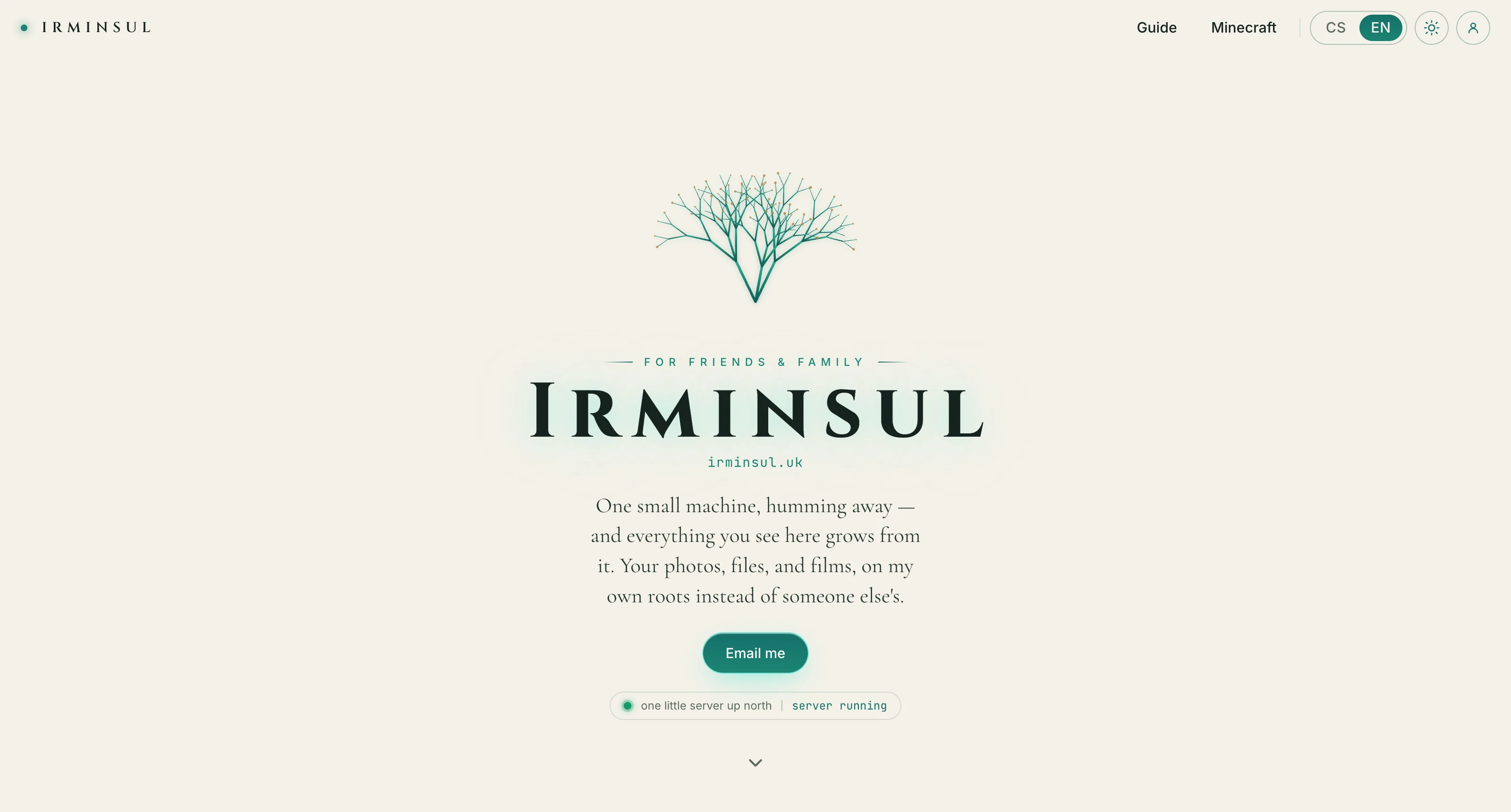
Family accounts get photos in Immich, files in Nextcloud, films and series in Jellyfin, scanned documents in Paperless and notes in AppFlowy. Friends mostly come for the Minecraft server. Its hub at minecraft.irminsul.uk shows live status, plugins and the world map. irminsul.uk is the front door: after sign-in it lists only the apps that person may open.
Sign-in and permissions
Authentik is the one identity for everything. Apps that speak OpenID Connect, such as Immich and Nextcloud, sign in through it and create the person's own account on the first login. Pages with no login of their own sit behind the reverse proxy, which asks Authentik before it lets a request through. Groups decide who sees what: the admin console and the secrets vault are for administrators only, and the Minecraft member area is open to any signed-in member. Jellyfin, AppFlowy and Paperless still keep their own login. For the first two that is on purpose, because their TV, phone and desktop apps cannot follow a browser redirect. A session ends when the browser closes, unless the person ticks the stay-signed-in box, which keeps it for 30 days.
The console and the second factor
A private console, which also installs on a phone, shows every server with its containers and costs, who may open what, and the update queue ranked by risk. The console itself only reads. Administration needs a second factor on top of the password. Anything that changes the servers, such as rotating a secret, connecting a new repository or locking a person out, goes through a separate broker service, the only place that holds admin credentials. The broker asks for a fresh second factor, accepts each approval only once, wants the action confirmed by typing, and writes an audit line that leaves the secret out. For a stolen account there is one action that switches the person off in Authentik and in the apps with their own accounts and ends their sessions. It can be undone without losing any of their data.
How I run it
Deploys: a merge to main builds and ships. The job logs in to its own secrets project with GitHub OIDC, joins the private network for that one run and connects over SSH that is closed to the internet, so no deploy secret is stored in GitHub. Secrets: self-hosted Infisical, one project per service, nothing in git. Backups: every server backs itself up each night with restic to storage in another region, and the cloud server keeps seven daily, four weekly and six monthly snapshots. Each week a check reads back a sample of the backed-up data, and a restore drill loads a database dump into a throwaway container and compares the row counts, then restores the client sites' uploaded files and checks every file's hash. A third copy with a second provider is scripted but not switched on yet. Monitoring: Uptime Kuma and Beszel watch every site and server, and a domain check watches certificates and DNS. Failures reach Discord at once, and successes wait for one morning digest. Updates: security patches install themselves daily, and a full upgrade runs weekly, but only if there is a green backup less than 26 hours old.
What I decided
I kept it simple on purpose: Compose on plain servers, because the whole homelab has to fit in one head, and restoring a server should mean restoring its files and starting the stacks again. The price is that nothing fails over on its own, so the backups and the rebuild runbook carry the weight. Every lasting decision gets a short architecture decision record. There are fifteen so far.
Architecture
- CloudflareDNS as code
- Caddyforward-auth
- Authentiksingle sign-on
- Estate API.NET 10, replacing Honomy code
- Compose stacksone per app
Screenshots