Example API
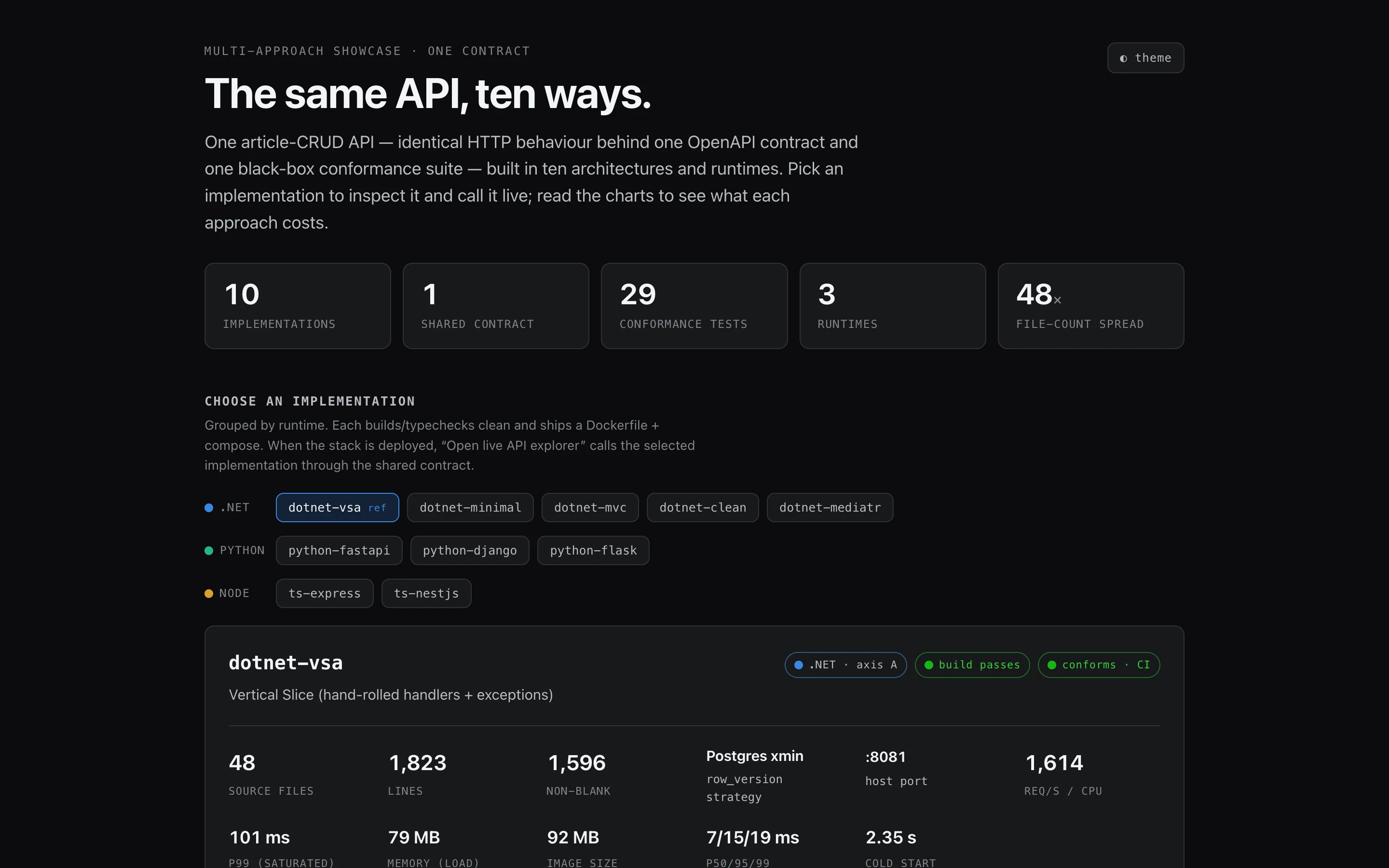
One CRUD + JWT API, ten implementations across .NET, Python and TypeScript — behind a single OpenAPI contract, benchmarked fairly.
Architecture
Interactive benchmark
The question
Does architecture — Minimal / MVC / Clean / MediatR / Vertical-Slice — actually move performance? And how do the runtimes really compare on the same workload, at what cost in code ceremony?
How it startedresearch
Wrote one OpenAPI contract, then implemented it ten ways: 5×.NET, 3×Python, 2×TS. A black-box conformance suite proves every implementation behaves identically before it is measured.
Decisions & tradeoffs
Resource-fair benchmarking with k6: identical workload, hardware parity, pinned versions, warm-up + measurement + cooldown windows. Report full tail-latency (p50/p95/p99) and coefficient of variation — not just averages.
Findings
Within .NET, architecture barely moves performance (~20% spread). Across runtimes the concurrency model dominates: multi-threaded .NET scales ~12× to four cores while single-process Node / FastAPI plateau. Code ceremony ranged from 1 file / 382 LOC to 48 files / 1,823 LOC.
Screenshots